Brief: Explore some of the factors that are at play in shaping the future of books globally by reading Chapter 7: The future of the book from David Finkelstien and Alistair McCleery’s An Introduction to Book History (2005).
I started off by printing off Chapter 7 as I felt this would be easier to highlight and make notes as I go a long.
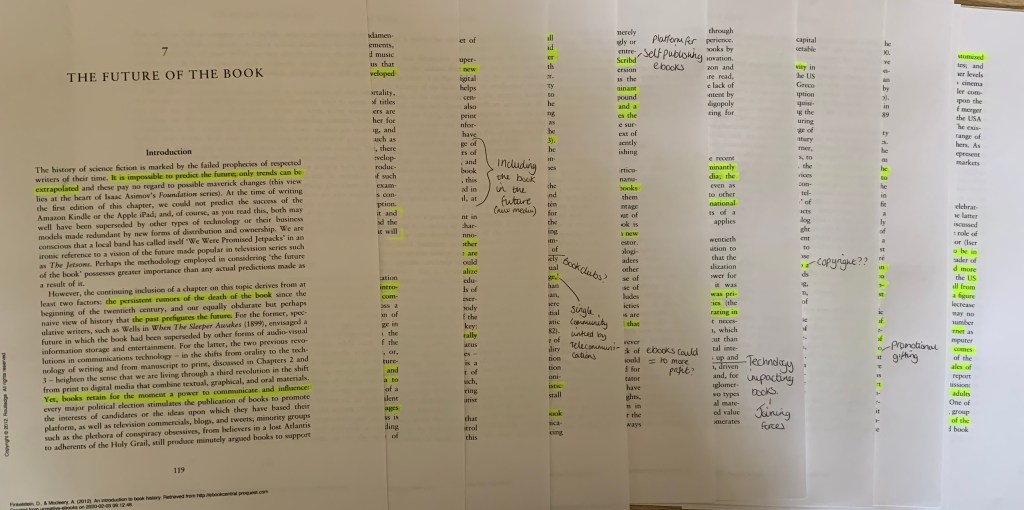
During this chapter, we read about facts, information and opinions contributing towards the direction in which the book could be heading. Some of the key points which I highlighted helped guide me to where I think the future of the book could be heading.
The two main points which I think will effect the books future is; the interest of the reader and the technology take over.
Technology
As stated in the introduction of the chapter (An Introduction to Book History Chapter 7: page 119) “It is impossible to predict the future; only trends can be extrapolated”. Over the past few years technology has rapidly developed, meaning that books are no longer our only source of information or the gateway to stimulate our creative imagination. As a young adult growing up with technology surround me, I can appreciate how technology is beneficial, however I also understand the negative impact it can make. I personally prefer to read printed materials, like this chapter for example, I attempted to read it online however I felt too distracted with the glare of the screen and the pinging of notifications.
It was interesting to read the ‘Technological Determinism’ sub chapter, this covering the main topic of how technology is impacting printed books. After reading this I feel that the use of eBooks will not ‘wipe out’ the existence of books, although, they could be more beneficial as eReaders offer different features in terms of learning and gathering information such as highlighting, built in dictionaries, bookmarks, notes and the feature to search for a particular part of the book all beneath your fingertips. eBooks can also bring more profit to the author/publisher in the fact that the books haven’t got to be printed or bound together, however as mentioned within this chapter there seems to be issue’s with privacy and ownership of eBooks, e.g. does it belong to the author or the publisher?
The Reader
Another part of the book which I found interesting was the ‘Death of the reader’ sub chapter. It’s been reported that there has been a fall from 56.9% of American adults reading fiction for pleasure in 1982 to a figure of 46.7% in 2002 (page 129) this is due to other activities taking up our time such as browsing the internet, watching tv, playing video games and social media. In this day and age I find it is hard for anyone to escape the reality of technology, although it is beneficial in most ways, it is also addictive! The quote below really spoke to me, because I feel that this is due to technology and the time we invest using them.
For the future of the book, nevertheless, the crucial issue is no longer illiteracy but aliteracy: those who can read but will not read books. – Page 130
As readers we are influenced by our next book, wether that be word of mouth recommendations or those of book reviews, even at times certain online retailers can suggest you books based on your purchase history. The things we read can be effected by our personal lives, it was interesting to read about what the average adult reads and when they start/stop (page 130) and that “52% found reading as a means of relaxing or relieving stress, 27% as escapism and 24% as an opportunity to exercise their imaginations.” (page 131)
I believe that the future of the book can also depend on the reader of books, if we continue to invest in the printed book industry then surely we can help keep it afloat? This would also help keep libraries and bookstores open.
It seems like the debate of printed and eBooks will be on going for years still to come, there are many advantages and disadvantages to eBooks such as storing many books on one device, or that you can have the risk of your device running out of battery mid sentence. The more I research the topic the more undecided I feel however, with the advantage of the eBook I feel that it is giving the book industry a chance to keep up with technologies, so that people who are into their gadgets may be swayed by downloading a book on their devices. I don’t think the printed book will die out, as mentioned before they are still one of the main learning resources, especially in developing countries and for people who simply cannot afford the devices. Plus the older generation still prefer printed books as many aren’t fans of technology, however once the older generation fades away, will this stop the popularity of printed books in favor for the eBook?
Reflection
I really struggled with this research task. I found it hard to keep motivation whilst reading the listed chapter and have spent way to much time on this, however once reading it all then skimming back over I managed to let the information sink in.
 rachaelmayesbook.design.blog